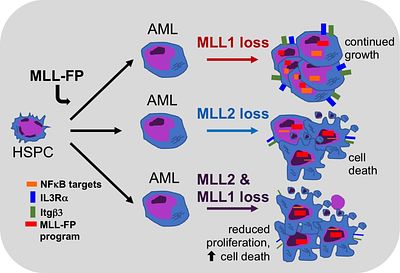
Chromosomal translocations within the MLL1 gene create fusion oncoproteins encoded by one of the two alleles. The remaining, wild-type MLL1 does not play a role in initiating or sustaining MLL-fusion oncoprotein initiated leukemia (PMID28609655 & 31161857) but its loss can rate-limit MN-1, Nup98-Hoxa9 or Nup98-Jarid1a initiated AML (PMIDs 33542482, 27889185 & unpublished), or BCR-ABL initiated B-ALL (PMID29351999). These observations suggest that therapeutic targeting of MLL1 may have value in particular settings. In contrast, we found that the closely related MLL2 (KMT2B) broadly controls key survival pathways in AML that have nothing to do with MLL-fusion oncoprotein deregulated pathways, making it an attractive drug target in AML given its lack of essentiality in the hematopoietic system (PMID28609655 & 30315824). In addition to understanding specific versus general roles of H3K4me3 modification by particular enzymes, we are interested in the impact of these enzymes/modifications on transcriptional plasticity and evasion from therapy.